|
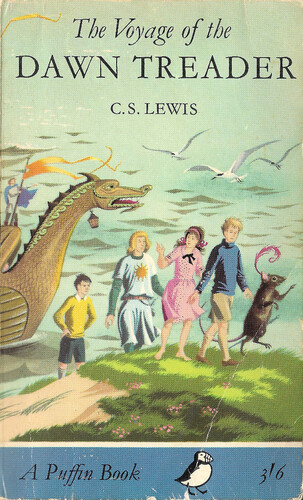
This was the third book in the 'Chronicles of Narnia' to be published, but it counts as the fifth if we adhere to internal chronology, whether Earth or Narnia. It unfolds a year after 'Prince Caspian' in our time but three have gone by in Narnia; King Caspian's reign having brought peace to the land. However, while 'The Silver Chair' follows only a season later in Earth time, that translates to fifty full years in Narnia. Nonetheless, that serves as a sequel to this from the perspective of Eustace, just as this is a sequel to 'Prince Caspian' according to that character's story arc.
I love the first line: "There was a boy called Eustace Clarence Scrubb, and he almost deserved it." He's a brat when we meet him, but he has the most substantial story arc, evolving considerably by the time the book ends. This makes him roughly equivalent to Edmund in 'The Lion, the Witch and the Wardrobe', but his arc is longer and more pronounced, being arguably the lead character with an ensemble cast around him. He'll be back for 'The Silver Chair', but without a Pevensie, as Aslan explains to Lucy and Edmund at the end of this book that they will never return to Narnia.
Eustace's parents are Harold and Alberta, who are described in a curious fashion: "They were very up-to-date and advanced people. They were vegetarians, non-smokers and teetotallers and wore a special kind of underclothes. In their house there was very little furniture and very few clothes on beds and the windows were always open." These restrictions aren't called out as moral in base but it's easy to read them as the tenets of a restrictive religious philosophy. Special underclothes suggests that the Scrubbs might be Mormons, but that doesn't seem to be the case. I looked this up and it seems likely that they're merely avid followers of fads. Eustace's claimed pacifism would play into this too, especially given that 1952 was only seven years after the end of World War II.
He's a cousin to the Pevensies and Edmund and Lucy are rather unwillingly going to stay with the Scrubbs in Cambridge. Their father will be lecturing in the States and mother and Susan are going with him. Peter's studying for an exam with Prof. Kirke, owner of the wardrobe, who's apparently moved to a smaller cottage since that book. That leaves Edmund and Lucy in need of a place to be for a while. The bad news is that means with the Scrubbs. The good news is that they don't spend much time there at all before they're whisked back to Narnia.
Once again, that happens in a completely new way. There's a picture of a dragon ship on the wall in Lucy's room. As the children look at it, it starts to move and draw them in. Before they know it, they're in the sea being hauled onto the Dawn Treader to be reunited with Caspian, now king, and Reepicheep, the brave mouse knight. The captain is Drinian and the first mate Rhince and the two former monarchs, Lucy and Edmund, fit right into this company. Eustace, on the other hand, hates every moment from the outset and complains both loudly and in the pages of the diary he keeps. He even picks on Reepicheep and is jabbed with the mouse's sword for his troubles. He apologises rather than face a duel.
The primary quest that constitutes the majority of the book is Caspian's to fulfil a promise made when he accepted the throne. He's left Trumpkin as regent while he sails east for a year and a day in search of seven lords of Narnia, sent away by his usurper uncle Miraz. Officially, of course, they were merely tasked with exploring the unknown seas beyond the Lone Islands. In truth, they were driven away so they couldn't side against Miraz as he consolidated his grip on the throne. There is another quest, as Reepicheep has a deeper goal. He wants to reach the end of the world where he believes he'll find Aslan's own country.
The first stop is on the Lone Islands, the only place we visit that's on Narnian maps and where the reign of King Caspian is even remotely acknowledged. However, there are villains here, as we find when five of them are captured by Pug and his slavers. Fortunately Caspian is promptly sold to the first of the seven lords, Bern by name, who immediately pledges allegiance. Caspian removes the corrupt Governor Gumpas from office, orders an end to slavery and gives Bern the castle and the new title of Duke. This is an utterly traditional progression but it's the last such in this book.
From here, we shift both into overt fantasy, in a form obviously influenced by myths and legends, and into Christian allegory, to a degree far beyond anything in the first two books. In fact, it falls pretty clearly into the genre of Irish literature called immrama, which is a subgenre to the earlier and broader echtrae. Echtrae are simply adventures, but they tend to follow a hero's journey. In immrama, the journeys are more specifically by sea and involve an episodic string of islands, told from a firmly Christian aspect that's laid over a bed of Irish mythology.
The only real difference here is that the Dawn Treader is travelling east from Narnia rather than west from Ireland, as the rest falls very much in step. 'The Voyage of Saint Brendan the Abbot', an immram from circa 900 AD has been cited as a template for 'The Voyage of the Dawn Treader' and that seems fair, though there are clearly other sources in Norse mythology and Dante's 'Inferno', maybe even some Homer. On the first land east of the Lone Islands, Eustace wanders off, gets lost in the fog and falls asleep on a dragon's treasure, waking up as a dragon himself. That's closer to the tale of Fáfnir than any of the uses J. R. R. Tolkien put him to in his fantasies.
For a while, everything seems to be pure fantasy, with that cursed treasure, a pool that turns any substance dipped into it to gold and an island of servants made invisible by a magician. However, the Christian aspect creeps in with the first fleeting appearance of Aslan and continues unabated until the finalé at the end of the world. The land beyond is pure white, fish aplenty to guarantee a firm absence of want. If there was any doubt, a lamb turns into Aslan, who tells Edmund and Lucy that he exists in their world too, just by a different name. "This was the very reason why you were brought to Narnia, that by knowing me here for a little, you may know me better there."
Even before we get to that point, it's hard not to acknowledge how this fantasy quest is gradually transformed into the Christian allegory the series has become known as. Aslan really doesn't do a lot here and he doesn't appear often, but every moment he has is pivotal. A religious apologist of the Christian persuasion would see Aslan as a guide here. As the characters follow their quest, an abundance of moments threaten to steer them away from an appropriate course of action. Aslan is who keeps them on the right path. However, an atheist would accuse him of being quite aptly a deus ex machina. Lewis was writing a fantasy but any time he paints his characters into a difficult corner, there's Aslan to intervene on their behalf and get them out of trouble.
As I mentioned in my reviews of both 'The Lion, the Witch and the Wardrobe' and 'Prince Caspian', that angle was there but it was never overt. Yes, Aslan was clearly Jesus but it never felt as if the point was Christian allegory; Lewis was merely adding a Christian flavour to his fantasy along with more prominent pagan and fairy tale flavours. Here, he's clearly writing Christian allegory, over a framework of mythological fantasy. There are no villains beyond the Lone Islands, because it's all about the characters facing themselves. What starts as a heroic adventure gradually transforms into a moral journey, external conflicts shifting to internal ones.
I liked it, but I liked it less than I did 'Prince Caspian'. 'The Lion, the Witch and the Wardrobe' is the most iconic, probably of the entire series, but it's all over the place when it comes to story. It may work best as a beginning, with 'Prince Caspian' the strongest actual story and this book starting a firm shift into Christian allegory. I'm now looking forward to looking back at the whole series once I've reviewed 'The Last Battle' in January to see if that's how I'll see it then. ~~ Hal C F Astell
For more titles by C.S. Lewis click here
|
|