|
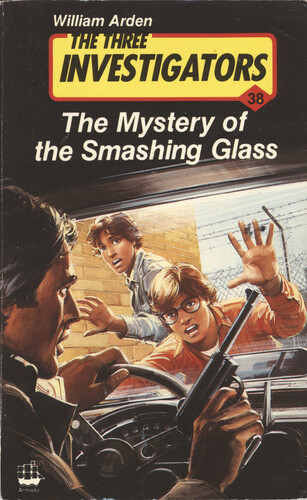
The baton passes back to William Arden so we're given a pedestrian introduction. Marc Brandel's only written two books thus far but I'm missing him already even before we get into the story. But hey, there's Uncle Titus! When did we last see him? It feels like forever. He's just the beginning of what soon feels like a greatest hits package for the 'Three Investigators'; a few opening chapters and we're given a ghost-to-ghost hookup, the gold-plated Rolls and the boys putting five different entrances to HQ to use while trying to catch an intruder who's planting a bug.
Given all that, it almost seems strange to say that this feels like a modern story, with not just one prosaic crime but two and a strong use of technology to solve their respective mysteries. There's plenty of good old-fashioned deduction in play, but Jupe gets ahead of the police through use of a data visualisation technique, as well. One good aspect to this mystery is that, very possibly for the first time, the Rocky Beach Police Department are already on the case when the boys are hired to investigate it. One bad aspect to this mystery is that they really ought to have figured it out over their concerted six-week effort. Kudos to the Three Investigators, shame on the RBPD!
As the title suggests, the core mystery involves the smashing of glass. The boys bump into it when Mr. Jacobs and his son Paul, who run a used furniture store in Rocky Beach, visit the junk yard on a buying spree and the former is upset with the latter. Paul's only recently earned his license and he hasn't driven the truck far, just to a friend's house. However, within only two months, the window has been smashed four times and Mr. Jacobs is not a happy man. Pete overhears and gives Paul a Three Investigators card. Apparently the same thing happened to his dad.
So to the ghost-to-ghost hookup and the Rolls and we start to learn just how big a problem this is. Their stakeout is a bust but a barrage of voicemails tell them that it's a real epidemic: a hundred and twenty seven separate incidents called in to HQ. It's always the driver's side window, always a vehicle parked on the street. When Jupe places different coloured pins into the map to represent different days, he learns that it only ever happens on Mondays and Wednesdays and only ever in straight lines.
They think up a bunch of viable theories but there's no evidence to back up any of them. Then, in a glorious scene, their next stakeout finds them captured by a police sting! It's quickly resolved, of course, first by Worthington and then by Chief Reynolds, but it also trawls in the second mystery, the theft of an eagle. Not a real one, I should add, after so many birds featured in the cast of the previous novel, 'The Mystery of the Two-Toed Pigeon', but a coin, Jarvis Temple's ultra-high-relief 1907 double eagle, uncirculated and worth a cool quarter of a million bucks.
I do like that the local police are working this case. Often, the boys tend to investigate mysteries that wouldn't tend to cross the desks of the police, whether they would be deemed trivial, simply not believed or because reporting them would feel embarrassing to the victims. Perhaps just as often, they start out investigating something that just seems weird and the crime aspect doesn't manifest until they get far enough to bring it to light. However, both these crimes are clearly the sort of crimes that the police should be investigating and it's good to see that they're putting in a substantial effort to solve them.
Because the police have put in so much legwork already, before the boys stumble onto a mystery about smashing glass, that means that they have more data. In a neat touch, Bob's dad's paper is happy to bring the Three Investigators onto their staff, albeit for a token dollar a day, just so the department can open up to them as journalists. They still can't see the police reports, but they're able to interview the cops who filed them to learn some of what's in those reports. That's almost as valuable as Jupe's data visualisation map.
And, even though the boys beat the police to the solutions, these are crimes that the police really ought to solve. That they fail to do so isn't just a black eye for the department; it's an opportunity for us. After all, if the police can solve it, then we ought to be able to solve it too, working entirely from clues that Arden hurls out for us to find. Beyond puzzle-based cases like 'The Mystery of the Stuttering Parrot' and 'The Mystery of the Dead Man's Riddle', this may be the best case thus far for armchair detectives. Everything's there for us to solve it before Jupe, if only we pay attention carefully enough.
Here's where I have to own up to only solving half of the mystery. I figured out who stole the eagle from clues given, but was only partway to identifying who was smashing the glass. The why wasn't too hard to identify but I hadn't acknowledged enough clues to explain how. From one angle, that suggests that it's a strong mystery; after all, while I was sixteen when I first tackled this on its UK release, I'm in my second half century now and really ought to be able to solve mysteries posed in children's books. I guess I'll take the consolation prize of being close enough that I'd have still got there before the Rocky Beach police.
I liked this one while reading but I appreciate it all the more after thinking about it for my review. It plays to tradition by trawling through many time honoured series components, but also feels as if it's thoroughly modern, with nothing remotely supernatural and everything utterly grounded. I thoroughly enjoyed Jupe's data visualisation too and I'm sure that resonated with me back on my first time through in 1987 as it plays into what I was doing with both puzzles and technology at the time.
There is another recognisable approach, but it's not one that was used often enough to become a tradition. That's the approach of having two separate crimes with two separate villains, that only intersect through what we might call convenience, but to the characters instead of the author. It makes total sense for one to play off the other as cover. This is similar to the approach that M. V. Carey took in 'The Mystery of the Sinister Scarecrow', but it isn't quite the same, as it always feels like two cases with two villains to us.
There are only five books still to go in the original American run of 'The Three Investigators' and only one of those is a William Arden, because Carey penned three and Brandel one. I haven't read the last Arden, 'The Mystery of Wrecker's Rock', before but I hope it stands up to this one as a firm reminder of how sad it was that the series was cancelled. ~~ Hal C F Astell
For more titles in this series click here
|
|