|
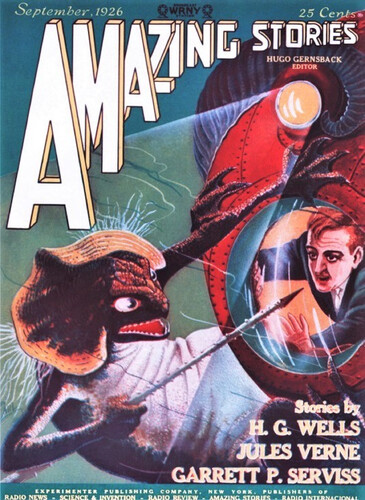
While editor Hugo Gernsback seems to be open to bringing new material to the public in this first dedicated science fiction magazine, something he'd done over the prior three issues, he seems to be even more keen to reprint older material. The only thing new in this issue beyond Gernsback's editorial is a poem by Beta called 'A "Psalm" of Light' that takes up the bottom half of the middle of three columns on the final page. In fact, over a three issue span that starts here, the only new material not verse would be one novelette by Alexander Snyder in the October number. That was intended for August but apparently got bounced back twice.
Instead, he concentrated here, at least mostly, on what could be considered commitments. There is another short story from H. G. Wells, 'In the Abyss', continuing a trend set in motion in the very first issue. Then there are serialised parts to three novels: the finalé of 'Station X', the middle of 'A Columbus of Space' and the first half of 'The Purchase of the North Pole'. However, I say "for the most part" only because there's also something unusual: a collation of six non-fiction articles from 'The New York Sun', a newspaper, in August 1835, that turned out to be anything but.
The headline above them read "Great astronomical discoveries, lately made by Sir John Herschel, L.L.D. F.R.S. &c at the Cape of Good Hope [from Supplement to the Edinburgh Journal of Science.] Sir John was a real scientist, who achieved much during a long and lauded career, especially in the field of astronomy, though he also invented the blueprint and coined the term "photography". He discovered four galaxies; co-founded the Royal Astronomical Society and proposed the names still used today for seven moons of Saturn and four of Uranus, a planet discovered in 1787 by his father, Sir William Herschel.
Crucially, he had travelled to South Africa in 1833 to catalogue the southern skies and didn't come back north until 1838. As such, his was the perfect name to attach to the discovery of a civilisation on the Moon, comprising a wide variety of flora and fauna, including winged humanoid creatures of both sexes, who stand four feet in height and are promptly dubbed "Vespertilio-homo or man-bat". They may or may not have been the builders of the equitriangular temple in the Vale of the Triads or the other two discovered shortly afterwards, as all three were deserted. Herschel even has an assistant, Andrew Grant.
If you're detecting doubt as to the veracity of these articles, you'd be absolutely right. Herschel had nothing to do with them, though he apparently found them amusing, and Grant was entirely fictional. 'The Sun' admitted they were fabricated after a month and Richard Adams Locke, who worked as a reporter on the paper, admitted to being the author in 1840. They were published in pamphlet form under his name and the title used here, 'The Moon Hoax'. There's a reproduction of the pamphlet's title page here with the caption that it was "the greatest newspaper hoax ever perpetrated".
Now, Edgar Allan Poe would probably disagree with that and he certainly claimed at the time that it was plaguarised from his 'The Unparalleled Adventure of One Hans Pfaall', which was published in the 'Southern Literary Messenger' in June 1835, only two months before these articles, also as a hoax but a deliberately more obvious one, with Pfaall journeying to the Moon to escape murder charges and returning with news that it's populated with humanoid life. He would later publish a further hoax, this time in the pages of 'The Sun' in 1844, recounting a three-day journey of Monck Mason across the Atlantic in a balloon, later to become known as 'The Balloon-Hoax'.
'The Moon Hoax' is a fascinating piece of literary history, but it's a notably dry read to a modern audience. Locke builds his hoax slowly but surely, the discoveries becoming bigger and better as he goes, and I'd guess that, even allowing for the more verbose language of almost two hundred years ago, did what he could to milk that to boost the likelihood that he would be believed. Poe's moon hoax failed because he endowed it with a satirical tone that enabled most to see through it. Locke didn't make that mistake. He stayed dry, serious and scientific and that helped to convince readers that it was true, even as it likely bored them in the process.
Today, it's a curiosity, a reflection of changing mindsets. In the early nineteenth century, with an advancing science far beyond the understanding of the majority of the public, people were happy to believe that there was life on the Moon and maybe we went to see it. Fast forward a century or two and science has reached the point where we actually did go to the Moon but people refuse to believe it. Blind optimism has been replaced by blind pessimism. I don't believe that counts as an improvement.
But back to the fiction that didn't pretend to be otherwise. The Wells story is different yet again from the others Gernsback had already reprinted, highlighting just how much range he had as an author. As the title 'In the Abyss' suggests, he focused his attention on the ocean, having Elstead build a giant ball, nine feet in diameter, of thick steel and glass. His plan is to take it down to the distance of five miles into the depths for a trip of about half an hour. Weybridge and Steevens do not believe any part of that plan is viable and that their friend will be surely crushed by the vast pressures that far down "like butter over bread".
Wells is keen to remind us how pressure increases with depth and he does it cleverly, by starting with small numbers near the surface and increasing them until the calculating character's maths fails him. He also figures out a list of specific doubts that a skeptic might have and debunks them in turn before anything ever happens. However, he does so vibrantly so we're not remotely bored by the time Elstead's nine-foot ball enters the water a page and a half in. What's more, he keeps us on the surface during that first journey, waiting and doubting with Weybridge and Steevens as Elstead's return gets more and more overdue.
It's all wonderful technique, though Elstead does return and brings quite the story with him. With that story told for the various characters who didn't accompany him to believe or not, the ending paragraph adds another level to the broader story in front of us. It's almost textbook stuff in how it unfolds and, while I wanted more from it, just as I did 'The Empire of the Ants' in the prior issue, this time that's a compliment rather than a complaint. More here would mean a novel to serve as a sequel. There it meant the other half of the short story.
I'll tackle the serialised novels in order of completion, meaning that first up is Jules Verne's 'The Purchase of the North Pole', which is an odd choice because, even though it stands alone, it's also the third in a connected series, that of the Baltimore Gun Club, who were behind the action in the 1865 novels 'From the Earth to the Moon' and 'Around the Moon', which count as a duology. This is different enough to count more as a continuation of their exploits rather than an expansion to a trilogy. It was first published in 1889.
The central conceit is that, at this point in time, nobody has ventured further north than the 85th parallel, so the four-hundred-thousand square miles of the Arctic are still up for grabs. Of course, nobody can get there, so what's the point? Well, the North Polar Practical Association thinks they have a solution to that problem so, when the United States government puts it up for auction, it's happy to cough up eight hundred thousand dollars to win it. They're Mrs. Scorbitt's dollars, as she is bankrolling the Baltimore Gun Club under a new name, but she has a taste for mathematicians and she trusts that its secretary, Mr. J. T. Maston's plan is sound.
It's big concept stuff and we'll have to wait for the second half of the novel next month to discover how it goes, but it seems that he believes they can move the North Pole, with all its vast deposits of coal, to the 67th parallel by changing the Earth's axis and melting the ice caps. If you're like me, you might be wondering what all the other countries of the globe will have to say about this idea, but for now, we remain with Maston, his mechanical arm and his artificial cranium, as he crunches the numbers on his blackboard of ten square yards. Verne devotes seven paragraphs in praise for his blackboard style, so it's impeccable stuff as he designs this climate change.
While 'The Purchase of the North Pole' is presented in two halves, the other two novels serialised in this issue are in thirds. Garrett P. Serviss's 'A Columbus of Space' reaches its second, with a very optimistic introduction. Apparently Ala's people on the sunlit side of Venus live in floating castles anchored to their planet with vast chains. There are skyscrapers a hundred storeys high, but our heroic explorers from the Earth are placed in the dungeon to await trial for murder, having shot a flying ship out of the sky to avoid a collision at the end of the first instalment.
The romantic side is entirely predictable, if enjoyable enough, and there's plenty of action. They escape, parley, submit for trial and are eventually dumped, quite literally, in the twilight zone, in a deliberate attempt by a jealous suitor of Ala. She and Edmund Stonewall are clearly an item at this point, not least because she claimed him in court. Other details include the lack of weapons in this society, even though everybody's telepathic, and a relationship between colour and sound to these people. In some ways, they're more advanced than us but they don't even know that other planets exist. After extracting some uranium from pitchblende, Edmund takes Ala up to see.
That leaves 'Station X', which concludes here, G. McLeod Winsor's novel expanding in scope to the equivalent of 'The War of the Worlds' conducted as a naval battle. With Macrae now possessed by a Martian, Prof. Rudge firmly becomes the lead character and the story accordingly moves clearly into 'Quatermass' territory. While the Earth is thrown into the shadow of a worldwide storm that blocks radio signals, Rudge returns to London to orchestrate his response at the highest political levels. Damn, this one warms up in a hurry as it approaches its finalé. I have to say that where we end up is not what I expected from the first instalment, but I enjoyed this one, all the way down to its happy romantic ending.
And with the poem by Beta, a pseudonym never used again and apparently still unknown, notable mostly for its ability to throw the names of scientists into rhyming verse, that's it for this issue. It continues to feel good to visit or revisit Verne and Wells, though Poe is increasingly notable by his ongoing absence but I'm digging the novels by names like Winsor and Serviss who I had never read before. They're very much products of their time but they're highly enjoyable for fans of this era of science fiction, where planetary romance was still dominant but adopting radio and other new technology as it comes along. I look forward to more of this sort of thing.
Next month, the belated Alexander Snyder novelette makes its appearance on the third time of asking. Both 'A Columbus of Space' and 'The Purchase of the North Pole' conclude and Wells shifts from short story to novel, with the beginning of 'The Island of Dr. Moreau', which I know passably well from adaptations and sequels by other hands but may never have read. However, instead of the advertised short story by Fitz-James O'Brien, which rolled back to December, there's the first half of a novella by A. Hyatt Verrill. See you then! ~~ Hal C F Astell
For more Amazing Stories titles, click here
For more titles by Hugo Gernsback, click here
|
|