|
I mentioned in my review of the September 1926 issue of 'Amazing Stories' that their promise of a lot of Verne, Wells and Poe was falling short with the latter. As if acknowledging that, up stepped 'Weird Tales' with a poem of his called 'Eldorado', originally published in 1849. However, while the vast majority of 'Amazing Stories' was reprint material, that's not the case here. There's another reprint poem, 'Ozymandias', one of Percy Bysshe Shelley's greatest; the 'Weird Tales Reprint', this time Sir Walter Scott's 'The Tapestried Chamber'; and one other story that's fairly detailed as the first in a new series but without adding that it's a reprint from 1910. Everything else is new.
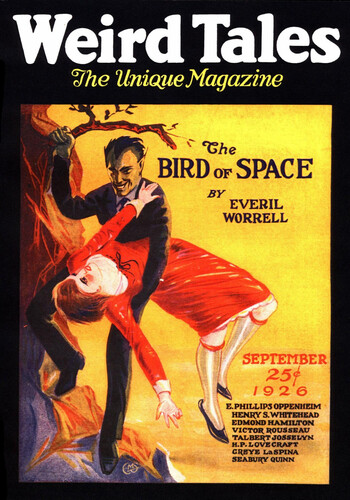
And the contents include some major names. There's the start to an Edmond Hamilton novel just a month after his very first published story. There's an E. Phillips Oppenheim, forgotten today but a prolific and popular author at this point. His name appears on the cover above many others who we remember better today, especially H. P. Lovecraft, Seabury Quinn (another Jules de Grandin) and Henry S. Whitehead, who's represented here by his most famous story, 'Jumbee', the title of the 1944 Arkham House collection dedicated to his work. It would become a Weird Story Reprint in 1938. There's also an August Derleth, but it's a 'Five-Minute' story he co-wrote with Marc Schorer.
The cover story is a novelette, the first of eighteen stories from Mrs. Everil Worrell Murphy, who would continue to appear in 'Weird Tales' until 1954. Her most remembered work is probably 'The Canal', anthologised many times and adapted into a 'Night Gallery' episode in 1973 that provided a debut directorial credit for Leonard Nimoy. 'The Bird of Space' boasts an evocative opening, as we catch up with the Canadian Pacific as it rushes through the landscape like a comet. A bunch of passengers are enjoying the rear platform, but they're shuffled off it because, on the train's last three trips, people have disappeared off it right here, while in motion.
That safety measure doesn't help. Frank Alison is promptly taken from his sleeping car, bound and drugged, left within Castle Rock. I should note that Stephen King borrowed that name from 'Lord of the Flies', so now I wonder where William Golding got it. Alison, of course, doesn't care because he's busy surviving a close encounter of the third kind. Apparently, the double-jointed green man who calls himself Gorlog plans to take six humans to his home planet that orbits a dark star. They listen because he has a disintegrator gun, long before Marvin the Martian, and is merely waiting for the Bird of Space to fly them there. Hopefully we'll find out what will happen then next month because Worrell's short story in that issue, 'Cattle of Furos', is a direct sequel.
While Worrell has the cover and the serialised novel in progress is Greye La Spina's, they're two of only three female authors in this issue, the other being Mary Sharon. Her short story, 'The Cat of Chiltern Castle' is easily the weakest of the three, a quick and obvious "unusual ghost story". It's her last contribution to 'Weird Tales', the previous two, a short story and a poem, both appearing in February 1924. This one follows Gene Winthrop, who owns a cabin in the Tetons and invites his cousin Mary to hunt elk. Gene believes in ghosts and recounts the story of an acquaintance, Tom Grant, who inherited "a debt-ridden old ruin", the Castle of Chiltern, and its cat, a family ghost. It tears Tom to shreds and, well, the only surprise from there is how quickly the inevitable happens.
The third instalment of 'Fettered' fares much better, with the first real signs of male strength in a story otherwise dominated by female characters. Dr. Dale Gillespie rushes in to save Bessie from his wife Gretel, but then we learn it's his fault that she's like she is. So we dive into her back story, which is even more unusual than I expected for an unusual vampire novel. She's a German, Gretel Himmbeeren by birth, and highly talented: quick to learn and fluent in five languages. Her father is a professor but he dies and that leads to the tragedy. Have you ever read vampirism conferred by a cat running across an open casket? Me either. This novel will wrap up in October.
There's a second novel in play here, because Edmond Hamilton, not yet anyone of note but firmly on his way with a short story in the previous issue and now the first third of a novel in this one. It's 'Across Space' and it brings an unusual vision. Mars stops dead in its orbit, though its moons carry on regardless. Allen, an assistant professor of science at Berkley, goes to Dr. Jerome Whitley and discovers not only that Mars is now falling towards Earth but that the key appears to be a volcano on Easter Island, Rano Kao. Whitley has personally found it extinct but it seems to be erupting. A flight over there shows that it isn't, because the vast amount of red isn't lava but immense light, half a mile thick, leaping up to Mars for three minutes each night. More next month.
With the serialised novels out of the way, let's look at the series because there are two. The first is the new one, 'The Case of the Jailer's Daughter', which starts a series about 'Dr. Ivan Brodsky, the Surgeon of Souls'. This was originally published in 'The Globe and Commercial Advertiser', an evolutionary step for a newspaper founded in 1793 as 'American Minerva' by Noah Webster, best known for his dictionary, but ended life in 1967 as 'New York World Journal Tribune'. Twelve of the thirteen eventual stories were published in 1910 under the pseudonym of H. M. Egbert, the first eleven in this newpaper.
'Weird Tales' chose to reprint eleven of them over eleven consecutive issues, starting in this one. The first half followed original publication order, as we might expect, but the second half didn't, a puzzle I look forward to unravelling. The magazine omitted the ninth story, 'Homo Homunculus', again for reasons unknown, and the final story, 'The Cats That Looked at Cohen', originally from the May 1911 issue of 'Canada West Monthly'. The latter was also not collected into 'The Surgeon of Souls', published by the Spectre Library in hardcover in 2006 in a strictly limited edition of 200 with a foreword by Mike Ashley. Maybe that one's lost.
After all that buildup, it's a relatively straightforward story, though the series has potential. Dr. Ivan Brodsky reads, studies and treats obscure brain lesions. Everyone should have a hobby! He's also an expert hypnotist. This first case is of Radovitch, a huge Slav miner with the intelligence of a child and an "extreme symmetry of feature" "constantly associated with the criminal type". He also murdered his wife, set fire to the house and tried to claim on insurance. Of course, he got the chair instead and we join him as he awaits his execution. He's duly killed but somehow returns as a personality inside his friend, the jailer's daughter. Dr. Brodsky is sought for a solution.
While I'm interested in what Dr. Brodsky will get up to next, I'm already interested in what Jules de Grandin will get up next and his seventh appearance is here in 'Ancient Fires'. It's not as weak as 'The Dead Hand' but it's tamer and more conventional than the other five that went before it. De Grandin finds a wanted ad that offers ten grand for "a man of more than ordinary courage", a description he identifies with. It turns out that M. l'Avoué has a client who wants to sell the house known as Redgables, but is restricted by its ghost.
Redgables is, of course, vast as haunted houses tend to be, even in New York state, but it also has an interesting history. It was built by a Brit who served in India, John Aglinberry, who went ghazi by falling in love with a native girl, a match his family would never allow. M. l'Avoué's client is also John Aglinberry, but the original's grandnephew. The story rattles along at a rate of knots but is fundamentally just a standard reincarnation story thrown at the framework of a haunted house, complicated a little by characters from a few different ethnicities.
I'm interested to see what readers in 1926 thought about it because 'The Eyrie' showcases letters from a few who found 'The House of Horror' in the previous issue too much. One such memorably wrote that, "It holds your attention spellbound while reading it, as a snake does a bird, but leaves a feeling of revulsion afterward." Ironically, most of 'The Eyrie' talks about the best stories in the magazine, not just of a particular issue but thus far and Seabury Quinn had five in the top thirty. I would not be surprised if they were all 'Jules de Grandin' stories.
In between 'The Case of the Jailer's Daughter' and 'Ancient Fires' is a poem, as was often the case when a story finished with space left on the page. Nowadays, that space would be taken up by an advert, but 'Weird Tales' kept those at the beginning and end, so used poems as filler instead. At this point, I haven't been particularly impressed by them, as indeed I'm not with the A. Leslie that appears here, 'Elysium'; a Sidney Lanier called 'Barnacles'; or, quite frankly, the Poe. However, it must be said that the poem in this gap is one of the greats, a Percy Bysshe Shelley that I bet you can quote, even though it only has fourteen lines. It's 'Ozymandias' and it's just as impeccable as when I read it last, however many decades ago. It says so much in such a small space.
Talking of classics, the 'Weird Tales Reprint' is from Sir Walter Scott, the second of his to appear in these pages after the vignette 'Wandering Willie's Tale' in January. It's 'The Tapestried Chamber', originally published in a literary annual, 'The Keepsake' in 1828. Ghost stories at Christmas are an English tradition, especially in the 19th century, and this is an extremely polite one, even though the ghost of Woodville Castle has a horrible corpselike visage. What makes it interesting is that it boasts a lead character on the losing side of the Revolutionary War. He travels back to the UK and finds a friend, Lord Woodville, who was his fag at Eton, a term left unexplained here.
Of course, there's only one 'Weird Tales Reprint' per issue, but two other stories, appearing here for the first time, would become such much later: 'The Night Wire' in January 1933 and 'Jumbee' in February 1938. I'd only read the latter before, in a collection of Henry S. Whitehead's stories that took that name for its own, but the former is effectively creepy and well worth seeking out. Oddy, H. F. Arnold doesn't appear to have written much at all, this being his debut, followed by a novella for 'Weird Tales' in 1929 and another for 'Amazing Stories' in 1937. This is the one anthologised.
The night operator is John Morgan who's described as a double man, because he has the talent of being able to handle two instruments at once, receiving two stories and typing them at the same time, one on each instrument. That's a neat parlour trick. Here, he receives news from Xebico, an evolving story of how a thick mist has rolled in, out of the graves, and wiped out the city. The twist is pretty obvious, given that Morgan starts out slumped over his receiver, but it doesn't matter. I felt this story as much as read it, as a deliciously dark slice of discovery.
'Jumbee' is creepy too, in its way, but not so overtly, as Whitehead, an Episcopal minister, tended to underplay the horror in his stories to neat effect, this one included. Granville Lee of Virginia is in St. Croix in the Lesser Antilles, hardly an unusual location for Whitehead who had been serving as the Archdeacon of the Virgin Islands for five of an eventual eight years at this point. Like many of his stories, this one taps into local magic, through Lee talking with an expert, Jaffray Da Silva. In fact, the entire story is recounted through their conversation.
It starts creepy and then deepens. The latter had a friend, Hilmar Iversen, and the two agreed to warn each other if they died first. Iversen neatly keeps the deal, which could have been a story of its own, but, when Da Silva goes to see his body, he dips further into the supernatural, seeing first three Hanging Jumbees at the side of the road and later a sheen. It's not likely that readers back in 1926 knew what either were and that may still hold, even though folklore has pervaded horror stories and movies, so I won't explain them. Both, however, are wonderful visions, and they lend a powerful effect to this classic story.
The best of the other stories is the Lovecraft, one I don't recall ever reading but which works very well for me. It's powerful, in a different way to the Whitehead, and neatly descriptive, and follows an unusual approach. The narrator is in New York City looking at old architecture by night, which I can thoroughly appreciate. He meets a gentleman who becomes his expert guide, an unexpected docent tour that starts out valuable and gradually gets more and more creepy. It's a glorious look at what lies beyond, an approach for which Lovecraft was justly renowned, but in a very different fashion.
After the Lovecraft, I should look at the Derleth, though the two names weren't connected at the time. This is a 'Five-Minute Story', the second credited to Marc R. Schorer & August Derleth, after which there would be another fourteen with the names the other way around. This one is decent and a little unusual, but it's most notable for a fantastic final image. Messer Como believes that Messer Marri has bewitched his daughter. There's bluff and double bluff and eventually that one highly memorable image that outshines everything that went before it.
That leaves three short stories, each interesting but hardly essential. Two of them were written by prolific writers for other markets who only appeared in 'Weird Tales' this one time, E. Phillips Oppenheim and Talbert Josselyn. The former was English and wrote mostly in book form. He put his name to more than a hundred novels and almost forty collections between 1887 and 1943. The latter was American and wrote mostly for the slicks and the pulps, often sports stories, though it was 'Smuggler's Cove' that was adapted into a feature, surprisingly as a Bowery Boys film.
Oppenheim's story is unusual because it's told by a middle-aged female servant hired as a child. We eventually learn that she's Lizzie and she works for the Catherall family in a house outside Lynton, Devon, which is a lovely place. I've been there, a long time ago, and I'd love to go back. The house is as gothic as it gets, overhanging a cliff, on the other side of a chasm to a folly of unknown origin, Culborne Tower, which is haunted. The story is one of murder and suicide, but what resonates the most is the silence that follows. When the silence breaks, the story sparks and mood gives way to explanation. It's effective but also rather predictable, right down to its title, 'The Tower Ghost'.
Josselyn's story is 'The Bracelet' and it's unusual because its male protagonist is firmly under his wife's thumb and he knows it. What's more, so does the Widow Grayson, who sees every time that he submits to her whims, and that drives him even more nuts. So he plans to prank Mrs. Grayson with Col. Chase's Egyptian bracelet shaped like a cobra in the act of striking. It's supposed to have a unique talent, that of detecting adultery and killing the guilty. Needless to say, his plan doesn't go as he intends. It's a cool story but relatively straightforward.
And that leaves Dick Heine, an unfortunate choice of pen name, at least to posterity, for Richard Toole Heine, Jr. His story follows suit: 'A Creeping, Crawling Thing' unrepresentative and generic. However, it’s a quirky and enjoyable piece with M. Brécoux visiting Pierre Le Ristaut in Paris with the tools of his trade inside his handbag: a tiny bottle of black liquid, a silver teaspoon, a spool of white silk thread and Oscar, a lizard four inches in length. Le Ristaut wants him to acquire a paper from the belt kept about the waist of the Marquis d'Onan, even when he's asleep. It's a wonderful set up and the twist is a bonus, but I was still sad for Oscar.
All in all, this was another strong issue of 'Weird Tales', with a handful of standouts. Next month, the conclusion to Greye la Spina's 'Fettered' and the sequel to this month's cover story; a 'Weird Stories Reprint' from Charles Dickens; and more from Jules de Grandin, Dr. Ivan Brodsky and also Gerald Canevin, Henry S. Whitehead's avatar within his own stories. ~~ Hal C F Astell
For more titles by Farnsworth Wright, click here
For more Weird Tales titles, click here
|
|