|
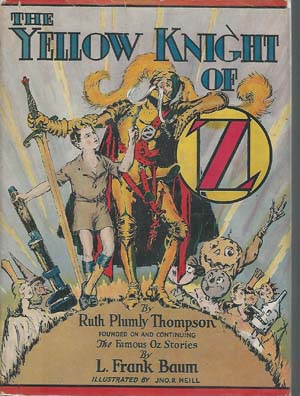
Twenty four books into the series and ten into Ruth Plumly Thompson's tenure as Royal Historian, 'The Yellow Knight of Oz' must be the most outrageously convenient instalment yet. I swear these books were written backwards, starting with a happy ending and working gradually back to figure out how it could all be shoehorned into place. This one's been five hundred years in the making, as that's when the kingdoms of Corumbia and Corabia vanished. To restore them, Thompson needs a traditional pair of plot strands to shake out the characters needed.
The first features Sir Hokus of Pokes, who wants to quest. After all, he's always been an Arthurian sort of knight who likes nothing better than to aid a damsel in distress. He's been enjoying life at Ozma's palace in the Emerald City, but he's become restless; as he explains to a mud turtle called Ploppa, "I must go forward and never shall I rest till I have saved a maiden, served a monarch, and destroyed a monster." Why Thompson uses "destroyed" instead of "slain", which would be a neat example of double alliteration, I have no idea, because she's very fond of wordplay and puts some in place in the mouth of Scraps on the very first page.
The problem is that he announces this intention to the court and everyone promptly decides that they want to go with him. Scraps wants to go, Dorothy too and Bettsy Bobbin, who suddenly has a second T for absolutely no reason whatsoever. Perhaps it's worth mentioning that this book, from 1930, entered the public domain this year, so anyone is free to publish a new version that removes that second T.
After that, they could follow up by fixing everything else Thompson changed for no reason in the prior few novels, "Gnome" to "Nome", "Gillikens" to "Gillikins" and "Jellia Jam" to "Jellia Jamb". None of those are here, fortunately, or they'd also want to join Sir Hokus on his quest. Oh, and all the directions, because Sir Hokus travels east into Winkie country even though that's west. Ugh!
It's when he realises that there are fifty gay courtiers outside also wanting in, that he simply ups and goes on his own. He doesn't tell anyone at all and it takes quite a while for them to notice he isn't there anymore. In fact, it's only when they notice that the Comfortable Camel has vanished that they realise Sir Hokus is gone too, as indeed is the magic picture that would have found them wherever they happened to be. Instead, the Wizard has a new searchlight that can do the job a bit slower. You fire it like a cannon and it travels around until it finds what it's been asked and flashes back the location.
Sir Hokus and the Comfortable Camel, because the latter followed on and found him soon enough, constitute the first plot strand. The second follows an orphan called Speedy, who lives somewhere in our world with his Uncle Billy, who's some sort of genius because he builds a rocketship to take young Speedy to Mars. Then again, he fits it with a steering wheel, which suggests that he doesn't understand much about rocketships. Uncle Billy is supposed to go along for the ride but takes too long to get in so off it goes without him. Speedy does a U turn to pick him up, but plunges instead straight into the Earth, finally coming to rest in a land called Subterranea.
This is an interesting place, because, according to a Subterranea resident called Zunda, it's placed at the bottom of the nine levels of the Underworld. Then again, he's seeking data. All he knows is: "First there is Neath and Underneath; then Low and Below. After that come Down, Upsidedown, Farther Down and Allthewaydown. Then Subterranea. We're about as low as you can get." They're ruled by "His Imperial Lowness, the Shah", who sits cross-legged on a giant blue earthworm. What really makes him stand out, though, is the fact that he only shows emotion through a selection of masks. That's pretty cool.
We don't spend long in Subterranea because once Speedy finds Princess Marygolden, who's a sort of living statue, he uses his parashuter to fire them straight up and out of there, all the way back to the surface, where he finds himself in an even stranger situation, being pronounced King of the Quix by their Chief Counsellor, Hurreewurree the Worst. Quick City is exactly what it says it is: the houses rush around so it's hard to get anywhere and the people age rapidly and then reverse the process. Speedy goes through that once and regrets it immediately.
We might consider what's going on in Samandra a third plot strand, but it connects to Sir Hokus's pretty quickly, because the Sultan, who's ruled that land for seven hundred years, is rather upset that he's lost his favourite camel. I'll give you three guesses as to which camel that is, but only the first one counts. To be honest, he doesn't care a whit about the camel but he does care very much about what's in its saddle bags. We do too, even if we don't know it yet, because it's the key to all that's happening. Everyone in play will end up in the right place at the right time to benefit from this little mystery.
While the plot conveniences are the book's worst aspect, almost prompting me to google around to see if there's a word that means more blatant than "blatant", the story that they choreograph into place is actually rather fun. I liked Sir Hokus escaping all the attempts to transform his quest into a parade. I especially like how Thompson bypasses a traditional reunion scene at that point: "Indeed, when I start talking about the celebrities at Oz-ma's court I never do know when to stop. To describe them all would take about three days and as you probably have not that long to listen, and know most of them as well as I do, I'll not try, but shall get back to Sir Hokus of Pokes and his quest."
I like the wordplay, at least the bulk of it, as I have done throughout all Thompson's books. Here, I couldn't help but raise a grin when it subter-rains in Subterranea. There's a gesturing jester who goes by Peter Pun. There's a seer seer. There's a horse chestnut that turns into a chestnut horse. There's even a flying field that is precisely what it says it is, a field that flies. That's what drops a thoroughly confused Sir Hokus and the Comfortable Camel into the right place at the right time. There's even one that I'm ashamed I didn't get immediately. Confido is the Imperial puppy in the sultanate of Samandra and he doesn't talk because no animal does there, for no reason except to set up the pun of his name. He's a Fido that the sultan can confide in.
I haven't mentioned everyone and everything that crops in this book because Thompson packs it pretty tight. However, you might have noticed that one character I haven't mentioned is the title character, the Yellow Knight of Oz. There are reasons for that and, if you're paying attention, you should have figured out what they are. It's a decent and satisfying story arc if you're a sucker for a happy ending, but it feels a little contradictory to what we knew going in. Then again, if in doubt, refer back to my notes about how often Thompson changes things for no reason. At least this is a sort of reason, certainly more than the other changes have.
Let's see what changes she makes next month, when I tackle 'Pirates in Oz'. I guess the title shows off one right there. Oz used to be a land without want or money but Thompson retrofitted that in a much earlier book, so now we have cities of failing industry and apparently pirates swooping in. ~~ Hal C F Astell
For more titles in this series click here
For more titles by Ruth Plumly Thompson click here
|
|