|
After three animal books for children through Julia MacRae Books, I have to wonder why there's no collective name in play to label them. They're all standalone stories with their own particular focus, but they also connect in a number of ways. They share a common location, even if not all of them start there, some characters having to travel there first. They share a common overlapping timeframe, with multiple characters appearing in multiple books, albeit shifting from focal point to background or vice versa.
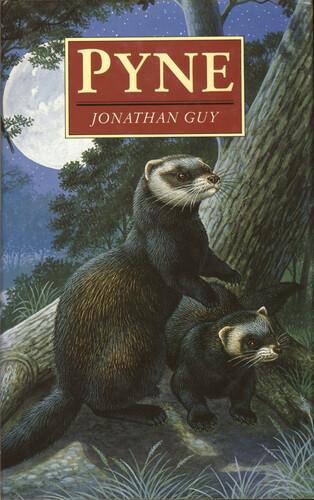
And, of course, they're all animal books for children, in fact stories that look at what happens on a broader scale when animals change locations. In 'Badger Island', Krag has to move his colony to a new home after their sett is attacked by Reuben, the poacher turned gamekeeper. In 'Rak', a fox is relocated from an urban environment into the countryside, where he has to learn a completely new way of life. Here in 'Pyne', a pair of polecats are driven from their home during a hurricane so have to adapt to a new environment not typical for their species.
As you can imagine, there are a lot of similarities between 'Pyne' and 'Rak', but the stories end up different because the species are different and the changes are different.
Initially, the change is almost a polar opposite. Rak was an urban fox who grew up scavenging on the outskirts of society. After he was forcibly relocated, he either had to learn how to hunt living prey or starve to death. Pyne and Cass, on the other hand, are wild creatures to begin with; they already know how to survive in the countryside. However, after the horse chestnut tree in whose roots they live is blown over, they run for their lives and end up in suburbia, where they suddenly have to deal with roads and houses and Man. They cope with the change better than Rak but still count as fish-out-of-water.
So they run again, ending up in the back of a pickup that takes them back into the countryside. It just isn't their countryside. Instead of mountains and valleys, there are fields and woods. It's not alien to them and they're hardly upset at the prospect of feeding on a wood full of pheasant, but they're something that Hopwas Wood hasn't seen before, a different sort of killer, one that kills indiscriminately and not always just for food. Therefore, they upset a balance that they weren't even aware existed, and the gamekeeper promptly hunts down what he considers savage, crazed killers.
By the way, that gamekeeper is Jenkins, Reuben's predecessor, so we know we're before 'Rak' at this point and a good chunk of 'Badger Island'. Pyne and Cass talk with Krag at their original sett, soon before Cass is killed in a trap. It seems that polecats simply cannot resist exploring any hole or tunnel they stumble onto; that wouldn't have been a problem back in the Welsh mountains but it's Cass's undoing here. That leaves Pyne on his own, because there are no other polecats in the area. He still gets a periodic urge to mate but simply has no way to do so.
And considerable time passes, because he gets to watch scenes we recognise from earlier books. There's Reuben's attack on the badgers soon before the halfway mark. There's Badger Wood and Shaf leading the sett, now that Krag and Jetta are dead. And there's Rak, chasing rabbits without any realisation that they're food yet. Rak didn't know that Pyne was watching him at that point, but I remember a glimpse of Pyne in 'Badger Island', as Krag led his badgers on a quest for a new home. All that happens relatively quickly here, though it probably spans the entire timeframe of the first two books.
So we've been on familiar ground, both literally but also metaphorically, which brings me back to the similarities to 'Rak'. That starts with the forced relocation, though Rak's was at the hands of well-wishers who didn't want to see the urban foxes gassed to death and Pyne's is at the hands of Mother Nature. There's interaction with badgers, including temporary stays for Rak and Pyne in setts through different winters. There's the loss of a loved one, though Pyne's combines the pair of Rak's. Rak lost his mate in the relocation and his companion to a snare; Pyne lost his mate to a trap. Of course, even though the two stories have similar beats, they're still very different.
And Pyne's goes on, eventually to a happy ending, which ought to make readers happy after 'Rak' wrapped up in such a downbeat way. It's a little convenient but only a little, because there's logic to it as well. I won't spoil it but I will point out that it definitely takes the broader story past both 'Badger Island' and 'Rak' because there are no huge roars in either of those books, courtesy of an ill-advised zoo that opens up in the village. There are definitely roars here and they shake up the whole area, because none of the animals indigenous to the area have a clue what's making them and all promptly run for cover.
I'd call this one my favourite of the three, but I could see any one of them chosen as a favourite by different people. 'Badger Island' has more of an epic quest feel to it and it's the best introduction to the "series" because Krag's journey involves many other characters. 'Rak' is more focused as a story and is easily the most meaningful, also providing an important lesson. 'Pyne' unfolds over a longer period, so feels less rushed and less urgent, but it also features plenty of highs and lows on its way to that eventual happy ending.
Of course, I have to wonder why I felt more sympathetic for Pyne than I did Krag or Rak. After all, Krag was an old badger doing his best for his colony against trying circumstances and Rak wasn't at fault for any part of his plight. Both were highly sympathetic characters in highly sympathetic situations. However, I felt more for Pyne's loss, both his original home and his mate, and I wanted him to find a way forward more. Maybe part of is that he's more alone and for longer, Krag having his colony and Rak finding a companion and mate sooner. For the longest time, it's just Pyne and I felt that isolation. Maybe part of it is that he makes better decisions, not that Rak's bad ones are his fault. Maybe it all adds up.
Next month, I'll take a look at 'Hawkwood', Smith's last of four children's novels for Julia MacRae Books, each in handsome matching hardcover editions with gorgeous covers. I haven't read that one before, but I'm guessing at this point that it'll overlap with these three. There are two later books under the Jonathan Guy pseudonym, 'Cornharrow' and 'The Minster Geese', and while both are also animal novels for children, I believe they're unrelated otherwise. ~~ Hal C F Astell
For more titles by Jonathan Guy (aka Guy N Smith) click here
|
|