|
'Rak' is set in the same universe as 'Badger Island' and shares some of the same characters, so we can tell that we're in the same place a little later than the events of Guy N. Smith's previous book as Jonathan Guy. However, it doesn't really count as a sequel, because it's fundamentally about a different character of a different species. It also carries a very different tone, almost the precise opposite to 'Badger Island'.
Instead of a character who leads his people to a safe place, it's about a character who's taken out of his safe place and thrown into a different environment, one for which he isn't at all equipped. It starts sad and it ends sadder, regardless how much hope it generates in between. Sometimes it's not enough to grow and change and adapt, because a fish out of water isn't a tenable place to be. In many ways, it applies one of Smith's standard tropes from adult novels in an unusual way: a city dweller moves to the country without understanding the local ways and suffers the consequences. Usually, that's a human being who wants to get back to nature. Here, it's an animal and it isn't by choice.
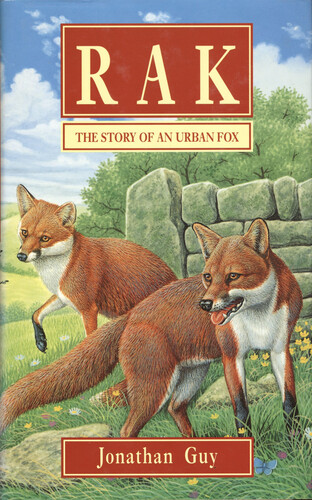
That animal is Rak, of course, who's a dog fox. As the subtitle suggests, he grew up on the fringes of the city, by train tracks and by Man. Neither has harmed him or his mate, the vixen Shi, but he did get a serious scare once when he unwisely ventured into a tunnel. It's a scavenger's life, with food plentiful in the city, these foxes living off the scraps of mankind. However, it seems that the times are changing. The rabbits seem wrong now and are gone for the most part. There are a lot of street dogs and cats now.
All this seems unusual for Guy, a rare shift into the city for an author known for stories set in the countryside, but he promptly pulls the rug out from under us. The foxes are trapped and caught, not by a gamekeeper or a poacher but by helping hands. The council has noticed the proliferation of the foxes and is likely to decide to gas them. Instead, well-meaning souls went in first, trapped them safely, loaded them into vehicles and freed them in the countryside. At least this way they'll live. Their part ends with a telling, "I hope they'll be all right."
And, of course, they won't be, because they're scavengers and the countryside is a different place to the train tracks. There's nothing out here to scavenge. Rak finds himself with Tika, another dog fox, as Shi is released somewhere else, and they immediately realise that they're completely out of their element, even before Rus shows up. That's how we know we're in the same place we were in 'Badger Island', because he was the fox from that story. He didn't play any real part in it, but he floated around in the background evading the hounds with his mate Tosca.
Foxes are territorial creatures and Rus effortlessly enforces his dominance over Rak and Tika, not least by being half as big again as them. He's also a legendary hunter in the area but Rak, hungry and unsure where to find food in the countryside, literally chases a rabbit without trying to catch it. He simply doesn't think of it as food. Clearly, there's much learning to be done. Of course, they eventually find food but we're well over a third of the way into the book when they stumble onto a dead ewe and Tika is caught in a steel trap and shot. Rak is on his own now, a stranger in a strange land, surely wondering how long he might survive.
I won't go further than that, except to talk about characters who return from 'Badger Island'. The wood is still there for one, as a regular character in Smith's novels. However, while it's once more identified as Hopwas Wood, we don't get the tour. The badgers still call it home, but Shaf is their leader now. It proves a temporary home for Rak and the backdrop for crucial lessons. One badger named Ben turns out to be the one at the farm after Baal. He was let go in the end too and found his way to the others, but is therefore a little more knowledgeable than them in the ways of man. Accepted but not fully by his own kind, he's happy to pass on that knowledge to Rak.
Of course, we've met Rus already and we'll meet Tosca later as well. She had an even smaller part in 'Badger Island' than her mate, but she gets more time than him here, not least in becoming an important teacher for Rak. He proves to be a willing, if not particularly able, student. There are a slew of other animals on the periphery, most of whom wonder at how strange Rak is. One of them is Pyne, who was also mentioned in 'Badger Island' and who would become the subject of the next Jonathan Guy novel a year later.
There are human characters too, but they're kept even more at a distance than they were in the first book. The well-meaning souls at the beginning remain anonymous and don't play any further part in the story after releasing the foxes into the wild. Ben talks about Man to Rak but, unlike in the previous book, we never visit the farm where he was kept as a pet. Rak does venture into one village and is driven away by shotgun blast. Hunger prompts a return but a rather dangerous one. Jenkins and Reuben, the original gamekeeper in 'Badger Island' and his wicked replacement, are mentioned only.
While this is another animal character study with Guy turning his eye to a different species, it's a cautionary tale at heart. Rak and Tika learn that Man is different in the countryside. By the train tracks, he left them alone. In the countryside, there are shepherds and gamekeepers very willing to wage war against foxes who pester the animals under their care, though regular villagers only fire warning shots to keep them away from their bins, rather than to kill. Wild foxes know this and hunt appropriately, though Smith introduces a game changer here in myxamatosis, removing the local rabbit population that serves as a primary food source for foxes. City foxes unwisely brought into the wild don't know this and mess up the local ecosystem just as effectively.
As sad as this story is, it's that cautionary tale that rings brightest and truest out of this book. It's crueller to rescue urban foxes and release them in the wild than it is to just leave them be for the council to exterminate. That's because, in the latter scenario, only the foxes die, and quickly. The former has knock-on effects to both humans and other animals over a longer period of time, with no difference in the outcome for the urban foxes. If there's a target audience for this book that's not traditional readers of animal stories, it's the well-meaning souls from the early pages.
Smith clearly had sympathy for foxes like Rak, the personification here of a scenario that he likely encountered personally up on the Welsh border hills. That sympathy bleeds off every page. Yet, I vividly remember one time I took the train down to do bibliographic work with him. He picked me up at the station in Clun and we set off for the Black Hill but he stopped partway to retrieve a fox that he'd shot on the way to get me. As we loaded it into the boot of his car, he pointed out that it had been troubling the animals on his smallholding. That would have been a few years before this novel was published and so I never asked him if that was an urban fox out of its element. Looking back, it could well have been. ~~ Hal C F Astell
For more titles by Guy N Smith click here
|
|