|
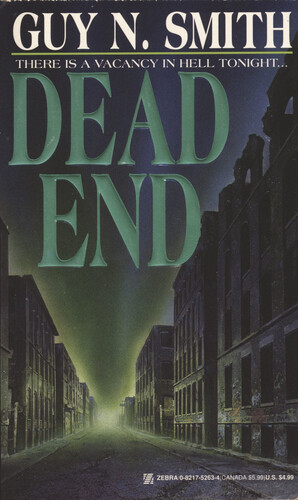
Sixty books into my Guy N. Smith runthrough, it's easy to see the go-to themes that he went back to time and time again. I've talked about those a lot in these reviews and I've also talked about a few novels that took completely different approaches. Well, this is about as different as got while remaining within the horror genre. It's hard to note commonalities with anything earlier, except for another mass pile-up and the inclusion of another deaf character. Maybe there's a momentary nod to 'The Unseen' but from the mindset of taking Ed Cain's near death experience and spinning it out to book length.
The lead is Max Frame, a driving instructor on his way to the hospital with his girlfriend, Shanifa, who works in a café, because her sister Wanda is in intensive care after being hit by a drunk driver. Max is married to Janice but she left once he started this affair and refuses him a divorce, hoping he'll return to her. It's a day before Christmas, it's sleeting hard and the traffic is heavy, so it isn't too surprising when a lorry ploughs over from the other carriageway, causing a mass-pile up. The Fiat in front of them is crushed and Max has to be cut out of his car by fireman. Shanifa died right there at the scene.
He isn't out of hospital until late March, still limping, and that's long enough for him to miss the dual funeral of Shanifa and Wanda. How's that for a happy start? Well, it dives a lot further into darkness from there. Smith doesn't name Max's town but it's an archetype for changing Britain. Southside is posh, with huge houses and plenty of room. Northside isn't, with council estates and terraces. If this didn't feel like England from the tone, the terms are quintessentially English for an American paperback, this being Smith's third of four for Zebra. Did Zebra readers know what council estates and terraces were?
Max walks through Northside, almost out of a sense of penance, and he identifies with the urban decay. Pubs are boarded up, factories are closed, a corner shop faces a new supermarket opening soon that will likely put it out of business. There's a bypass imminent, routed through Northside, of course, because Southside would never allow that. And, at the end of Northside are a collection of wooden barriers and then it's the Ghetto, which was the original title for this book. This is a place of superstitions and urban legends.
And that might suggest a direction but it isn't the one that Smith takes. Instead, he has Max see Shanifa in the Ghetto and so walk through the barriers. That prompts his watch to stop and a new town to manifest, some sort of weird netherworld that's dark and depressing but also vivid. There are lights and people and a café called the Grill and Shanifa works there, still dead but continuing on how she did in life. Smith was inherently rooted in the British countryside and that pervades a majority of his horror novels, but this is dark urban fantasy, something very new for him.
Of course, this isn't fantasy in the sense of elves and dragons. It's fantasy in the way that the city beyond the city occupies multiple spaces at once and constantly morphs without allegiance to the laws of physics. We later learn that the Ghetto is called Pace Park in what we might identify as the real world. Away from it, in the netherworld where clocks don't work, it's empty until it isn't, tiny until it isn't, safe until it isn't. It's the Waste, with tumbleweeds cannibalistic Downers until it's a sprawling city: cold, brutal and affluent. It's capitalist, with corrupt mayoral candidates running drugs and women, but also communist, with work and accommodation assigned centrally without checks.
I have to wonder if this was written in two halves, because I thought I owned this as a handwritten manuscript, but I actually only have the first half, in which very few characters focus. Max Frame is the lead and Shanifa continues on as a major character even after her death, but that's it thus far. We might expect that Dr. John Stackpool, who examines Max, after he makes it back to Northside, will be a third but he isn't. He's gone quickly, handing over to Chief Insp. Horlick, who vanishes just as quickly.
Eventually, it becomes Nat Bonner, that deaf character, who Max taught to drive. He's also had a recent loss, mourning, Sid, his father. Sid's in Hell, he says, the city of the dead, and Nat has been there too. They're a natural team, especially as Nat can intriguingly hear in the Ghetto. We know Smith wrote deaf characters because one of his children has only partial hearing. However, each time he's done that, he adds something supernatural to get past it. In 'Deathbell', the busload of deaf school kids can't hear anything except the title object. In 'The Undead', Amanda develops a sense we don't have, to compensate. In 'Manitou Doll', Rowena doesn't change but does drive the story.
While the first half spends much of its time in the real world, dipping into the Ghetto as a kind of quest of discovery, the second is mired deeply in this netherworld hellscape. An election is on the horizon, with Stu Merrick having a very good shot against the incumbent, Ruben Quiles. The third candidate is a perennial third candidate, Luis Diogene, the executioner at the prison on the edge of the Ghetto. They're all some combination of evil and corrupt and any mild redeeming qualities are soon exposed as nothing but.
Stu, for instance, seems like a great step forward for Roxy Burgoin. She's been stuck in a loveless marriage to Ed and both are cheating, but when he admits it and leaves for his mistress, she feels her future is with Stu. However, she's just the latest in a long list, with most of his former women working the streets for him. The exception is Yolanda Morrison, who's in prison waiting for death, dealing with the periodic naked floggings in front of the inmate population. She's a connection to Nat, because Sid is working as a prison guard and they've got very close.
And so we find Max working as a taxi driver and Nat as a poster designer, living in assigned blocks that sit next to each other, each seeking their loved one with the goal of bringing them back with them, even though they're dead. That's a depressing sort of optimism, but it's what this has. It's a litany of loss, transformed into hope that surely can't be viable. Maybe there's a hope for people like Roxy or Ed, but we seriously doubt it. We can't imagine how hope might work for Max or Nat. And, quite frankly, whatever hope the people of the Ghetto have in their election, we just know it won't end well.
I found this book utterly fascinating, profoundly different to anything Smith had written before. He rarely set anything in towns or cities, but when he did, they tended to be smaller urban areas like Lichfield or Knighton or maybe cities chopped down into smaller communities like Moscow in 'Fiend' or wherever 'Wolfcurse' was set. If this is what Smith thought the essence of a city was, I'm not surprised he avoided it, because it's a combination of inner city English slum and Soviet gulag, masquerading as either the dark reality of a communist utopia, everything ruthlessly grey and in the hands of the unseen party, or a corrupt capitalist society of crime, the free market given zero restrictions, everyone and everything for sale.
I should add that there is an ending that potentially explains everything, but it isn't so clear that we can't conjure up different takes. This could be merely grief made manifest, feelings of loss so deep that they take physical form. It could be that crucial moment before death with life flashing before the eyes of the dying. It could be real, a mysterious world on the other side of a veil that a mourning soul can cross. Maybe it's Hell, as Nat suggested, where hope springs eternal but is just as eternally dashed. And maybe there's some sort of space/time barrier being crossed, given the newspaper stories we read at the end. It's all up to us to decide and, just as this isn't the novel he tended to write, this isn't how Smith tended to end his books either. ~~ Hal C F Astell
For more titles by Guy N Smith click here
|
|