|
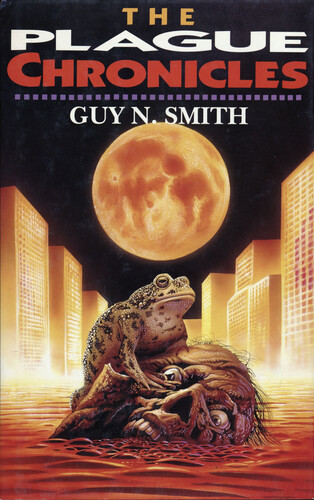
While I remember 'The Plague Chronicles' coming out in 1993, as another hardback from Piatkus, and Guy may well have sent me a printout of it before it saw publication, I'm pretty sure that this is a third novel in a three-year period that I didn't read for some reason. I read the next decade's worth though, except perhaps a couple of his pseudonymous children's books, until 2003 when I'd drifted away for long enough to have not picked up the following works until much more recently, not long before I started this runthrough.
This is a particularly odd one, most obviously because it reads like another horror novel set in the British countryside except for the odd decision to actually set it in the States. I'm not sure where in the States, the few named towns very possibly being fictional, and it's very possible that it was originally set in the UK, as usual, but poorly "translated" at the last minute in the face of interest from an American publisher. Certainly Piatkus only published this in the UK and that remains the only edition.
Quite frankly, there are more exclusively British terms in use here than there are equivalents in American English. There may be apartments instead of flats but there are also taps not faucets and Fall rather than Autumn. However, Ed is keen at one point to call in the Ministry rather than the applicable Department and Trevor sees his SUV clamped rather than booted. There are male characters who are uncircumcised, which doesn't feel right for a country that sees them as health hazards. I was surprised for a pickup to have a tailboard not a tailgate but apparently that's an interchangeable term in certain regions. Maybe that would highlight where we are, beyond just rural.
Maybe it was originally set in the UK because Susan Chibnell is British, but then maybe it's set in the States so her husband Trevor can be a believably different sort of outdoorsman. He's into all the things she isn't. He shoots and fishes, drinks and smokes, and has a very American gun fetish, completely distinct from a British field sportsman like Guy. He's even an atheist too and Susan's none of those things. At one point, when Susan suggests that the armies of bullfrogs massing by the toxic algae-ridden lake might be a plague, he tells her that she's overreacting, then talks up the imminent apocalypse through societal collapse. Those are very real people here in the U.S.
All they seem to have in common is their son, Mark, who's twelve and seems to take mostly after his dad. He's very happy when they travel up to their cabin for a week's holiday. Mum isn't. That's the spur for an early familiarity to fans of Smith's earlier work. He sneaks a shotgun and heads to the lake so he can shoot duck. Instead he finds himself in all sorts of trouble, the bullfrogs taking over and then being attacked by a similar army of crows. This reminded me of Gordon Shank's son Gary when he's attacked by crazed pheasants in 'Carnivore', another of Smith's novels to feature an array of species attacking mankind rather than just the typical one.
Other than the American setting, much of this will seem acutely familiar to fans. The land seems to be rebelling against what humankind has done to it, in a similar way to 'Abomination' and with almost as many small species of animal that get progressively creepier in large numbers. That's the best aspect of the book but it's hardly new ground for Smith. There's a biblical theme focused on the plagues of Egypt, but for no apparent reason; that least had story purpose in 'Accursed'. If we're dealing with biblical plagues, of course, one of them has to be locusts and Smith gave them their own novel almost a decade and a half earlier. Rather oddly, the biblical theme vanishes into thin air after the overtly religious characters die.
Less obviously, the primary characters are almost all unlikable. Trevor doesn't seem to care for a family he could happily do without, even before we discover that he's been screwing his secretary Elaine. At one point, both Susan and Elaine suggest they might be pregnant, which is a heck of an awkward situation for a man to find himself in! Eventually, Ed Parker and Doc Wycherly as the vet and doctor respectively in North Falls redeem the cast somewhat and Jimbo, when he shows up, is almost the exact opposite of everybody else up until that point, relentlessly cheerful and decent. For a weird hybrid of British and American, Jimbo (and a reclusive character called Donk) feel far more like Aussies.
As you might expect from unlikable primary characters, the tone is a depressing one, hearkening back to Smith's most pessimistic novels in the early eighties, like 'Bats Out of Hell' and especially 'Thirst'. However, it all wraps up with a bizarre optimism, a sort of happy ending that we weren't remotely expecting but feels like it could have been sourced from one of Smith's porn digests like 'Sexy Secrets of Swinging Wives'. Not everything is automatically set to succeed at this point, the vastly reduced population having to start again even after nature brings a traditionally quick but effective end to its torment, replenishing the tortured earth with purifying rain.
It's easy to see backwards at what Smith borrowed from earlier novels, often expanding on some of his previous themes. It's much less obvious to see forward to what he was trying to do with this one. I'd love to know how this changed during the writing process, but I don't have a synopsis and, while my printout certainly isn't identical to the printed book, with whole swathes of text cut for the published edition, it still seems to be American rather than British. I should run a much closer comparison to see what got excised; two hundred and twenty pages doesn't feel like it reaches a hundred-thousand words.
Oddly, given that this novel was clearly edited for publication, there's a whole slew of typos when it comes to punctuation. This was 1993, so very possibly an early digital layout and publishers had to face new problems like smart quotes. There are a bunch of backward apostrophes here and an annoying number at the end of dialogue, because of an errant space. This sort of thing should be caught in proofing, but I wasn't involved with that for another five years. I'm not looking forward to finding out how much I missed when we get 'The Busker' and 'Cornharrow' in 1998.
And so this is an odd one indeed. There's a lot to like here, especially for fans of Smith's work who will see themes and homages. However, there's a lot more than usual not to like, most obviously that weird hybrid of different English languages that starts out problematic and only gets worse. It's at times like this that I really wish I could just ring Guy up and ask him for the background that might explain why. Sadly, he's been gone for almost six years now and I doubt his family will have insight into this sort of thing. I can't imagine that the highly capable editor I worked with on later self-published titles would have let this sort of thing pass, so I can't even ask her. C'est la vie.
Next month, I'll drift into double bills because, after this, Smith started to diversify his output. It had been horror all the way, with occasional horror-tinged thrillers, since 'Killer Crabs' fifty books and a quarter of a century earlier in 1978. Up next though, he alternated five sets of adult novels with animal stories for children, with a western thrown into the mix in 1997 for good measure. So, in July, I'll tackle both 'Badger Island', under the pseudonym of Jonathan Guy, and a thriller, 'The Hangman', under another pseudonym of Gavin Newman. Fortunately neither is particularly long. ~~ Hal C F Astell
For more titles by Guy N Smith click here
|
|